Depth perception…

Depth of field, or DOF, seems to be a common area for discussion in photography, primarily because it is often subjective. What you choose for your depth of field in any particular image will have an impact not only on what is in focus and out of focus, but also on the impact the image has on the viewer. If your DOF is too shallow, a viewer may find the lack of a strong area of focus a turn off. Meanwhile, others may find the abstract nature of soft DOF appealing. Surely, DOF discussions are very much like opinions – we all have our own.

Having said that, there are some times when you would want a wider or a more narrow DOF depending on your subject matter. So, on that basis, it helps to understand how we can control our DOF. As I thought about this post, I came up with a total of:

Seven Tips to Control Depth of Field

  1. Aperture adjustments – the most obvious way, increasing aperture (decreasing the f-number or widening the opening) reduces your DOF, while decreasing the aperture (increasing the f-number or narrowing the opening) increases your DOF.
  2. Focus into the scene – by positioning the main point of focus into the scene, you can enjoy an increased range of focus for your DOF as a certain portion in front of, as well as behind your fosucing point will also be as sharp as your specific point.
  3. Parallel Planes – another one that is rather unique to macro photography, but when working with extremely shallow DOF values, it can help to keep your subject in focus if you position your camera back on the same plane as your subject. If you are not on the same plane, your subject will fall out of focus as it recedes toward the background and/or as it gets closer to the foreground.
  4. Use a tripod – especially useful in macro photography when you have a very shallow DOF – even the slightest of movements will result in a blur even within your specified DOF area, so stabilize the camera with a tripod when opening up the aperture
  5. Hyperfocal Distance – Jeff Revell dedicated an entire post to this the other day, so go to PhotowalkPro to read more about it. I kind of alluded to it in #2, but the more detailed answer will give you a better grasp of where to focus and how to achieve HFD
  6. DOF Preview Button – all shots in an SLR camera are viewed at the widest aperture opening so we can compose our focus point where we want it. However, the DOF preview button will stop down the aperture blades to out final aperture setting for us to give a preview of the range of sharpness through our image. Probably one of the least used tools on your camera (don’t worry, I forget to use it all the time too!)
  7. Change the focal length – your depth of field is also a function of the focal length of your lens. Longer focal lengths will be less able to produce a wider DOF (image is sharper throughout), while wider angle lenses typically can produce a wider range of sharpness to extend your DOF. This is partly why a wide angle lens is recommended for landscape photography.

Digital Frames

Too often we take our work and share it out on the web in galleries, on blogs, and at various community forums to see the background colors don’t really do our shots much justice. I’ve seen forums with blue background colors, others with yellow, and much much more. This has the net effect of casting a hue across every image in that space. Your images take on that hue to a certain degree, and it can often negate an image more than many realize.

Forum administrators and bloggers are starting to realize that neutrals are the best way to go, but there are still some web outlets that hang on to some rather outlandish color schemes. To accommodate the creative (and sometimes sensitive) differences that exist, it can often help to present your images with some digital framing. That is the focus of this weeks’ tutorial, and I share a rather simple but effective technique to create a digital frame to enhance or accentuate and draw attention to your imagery.

As I mention at the end of the post, there are some automated ways to create digital frames via plugins and actions. The one I reference can be found at www.atncentral.com People labor often in anonymity and share their work with the world and give it freely for others to use. Enjoy the benefits of generous folks and for those occasional ones that ask for donations, kick in a buck or two – it always helps to keep the creative spirit alive. In the meantime, keep on shooting (happily), and watch those apertures (carefully)!

Flash Version: Digital Framing

PlayPlay

PlayPlay

Day swap

I was having some issues with the post production and rather than hold off until late tonight to release the tutorial, I figured it’d be better to just swap Tuesday and Wednesday’s posts, so today is an early edition of my week around the web:

  • Jason Moore did his weekly round-up, and also saw his 600th post – congrats Jason!
  • Andrew at Visual Realia has a really great take on the theme of flowers and dewdrops – check it out for some inspiration!
  • I read up on the Copyright Law and Orphaned Works Act pending in Congress. Not good for us – good for corporations. Read up and submit your works today!
  • Thanks go out to Lisa, from Sage Family Studios, who is a fellow NAPP member for mentioning this in those forums.
  • Mark Brian, (sorry Brian, I am always wanting to call you Mark for some silly reason) from Professional Snapshots, has an image that will melt your heart (congrats again mark), and a Layers book review (by Matt K.) to make you green with envy (I want the book now).
  • The Online Photographer did an article on the sadness following the Kentucky Derby. If you are a softie like me, be warned, kind of heart-wrenching, and my heart goes out to the owners.
  • For fellow bloggers, this may be of most interest, as I finally took some time to read ProBlogger. I still have my work cut out for me! Definitely worth a read (or twenty) if you have the time – lots of ways to improve your niche, writing, style, professionalism, and much more!

Finally, it is worth noting that Dubai seems to be the hot spot lately. many of the most active and visible blogs on the web including the likes of Scott Kelby, Jeff Revell, Joe McNally, and now David Hobby, along with other notables have been visiting a growing body of budding photographers in the area. Some gorgeous and inspiring works have been posted over the last few weeks on all these guys blogs. Go check them out for a major dosage of creative inspiration here, here, here and here. If you stop in, take some time to share your thoughts with them – if you think I work hard at blogging and photography, it’s a drop in the bucket compared to these guys, both in breadth and depth! Amazing stuff out there…

Well, that should keep you tied over until the tutorial can get wrapped up tomorrow afternoon (I’ll forgo a morning post since this is going up later than normal). Until tomorrow; Happy Shooting and Watch those apertures!

Now is the month of Maying

There is an old saying that goes something along the lines of “April showers bring May flowers.” While this is generally a principle that holds true, in the photography world, it is also the time when things start really hopping. Below is a list of just some of the activities that drive the photography industry as we move into late Spring and early Summer:

  1. Wedding season kicks into high gear (wedding photographers)
  2. High school and college graduation parties are scheduled (which is great for portrait photographers)
  3. Engagements are announced (with anticipation of #1 the following year) (portrait photographers again)
  4. Family portraits are planned in conjunction with all of the above (portrait photographers yet again)
  5. A new season of sports swings into gear such as baseball, soccer, lacrosse, swimming, and countless other summer leagues (great for sports shooters)
  6. Mating seasons begin for birds (nature photographers)
  7. Rivers, streams, and waterways are teaming with new life (landscape photographers are just ecstatic)

Continue reading “Now is the month of Maying”

Freezing the frame (for Friday)

Read a neat little blurb in Popular Photography, May issue that I cut out and added to the “clip binder” recently…Four good rules of thumb for fast shutter speeds and what they translate to. So, regurgitated for you here today, are…

Four Frame Freezing Follies

  1. 1/1000th of a second will freeze action moving either up and down or across the frame.
  2. 1/500th of a second is good for aerials (coming in over a scene, like in a plane or along those lines)
  3. 1/250th of a second is good for freezing action coming straight at you (toward the camera – unless of course it’s my dog who comes toward you then lurches to the side for no apparent reason)
  4. 4 seconds takes objects in motion and turns them into streaks of light (think car headlights here – night photography will never be the same)

In other news, I also saw over on Jeff Revell’s blog today (PhotowalkPro.com) a great post on how to be a frugal lens shopper. Stop over there to read all about saving money. We bloggers love to get feedback too, so if you like it, make a post to let him know!

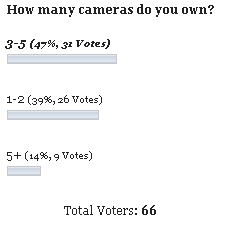
The camera poll has officially ended, and the results are in. Looks like many of us have at least a few cameras in our bags…fun stuff. Where did you fit into the picture? Thanks to the 66 that did join in for these last two months!

Check out the new poll listed today too…on audio podcasts! I am thinking of adding yet another multimedia feature (audio podcasts) to round things out (presently I’ve posted videos, documents, and pictures, so audio is all that’s left! Don’t forget to vote before you leave.

And, so no one feels left out from friday funnies, another week’s favorite episode from What the Duck:

What The Duck

Less is More…

Thursday Thoughts for May 1st, 2008

In photography, the idea of keeping your scenes simple is one that I know about, but all too often, forget to consider during composition. I typically will see something and move to take the picture without taking into account the surroundings. Then later on the computer, I see stray objects or shadows I didn’t see in camera, or more correctly, didn’t think to take note of in camera. So, I hit the delete key and try again some other time. Invariably though, the best shots I get are the ones where either by intent or dumb luck turn out to be the ones with the simplest composition. A dewdrop, a sunset, a boat, a leaf, a smiling face, whatever you like…they all have worked for me due in no small part (in my opinion anyway) to the absence of other elements in the scene. There are no barnacles or trash cans in the sunset shot, the boat and its reflection are the entire shot, and the smile is super close so everything else was thrown way out of focus. The images work due in no small part to the simple composition. The age old adage reveals itself again: Keep. It. Simple. Stupid. (KISS).

While the KISS idea is nothing new to photography, I am finding more and more that the same concept can also be applied to blog entries. Some of my most popular blog posts and video tutorials are simple ones. Short videos that are no longer than 2-3 minutes seem to be more popular, and post subjects that are easily read either in bullet points or numbered lists (Top 7 of ’07, Top Ten Landscape Tips, Top Five Lighting Rules, etc., etc., etc….you get the idea).

Just my random Thursday thoughts for the week – kind of photo related, but also tangential. Although I would suspect that this new-found knowledge may manifest itself in future postings, so…for those who stop in to get lengthy reads, enjoy them while they last – they could be gone tomorrow! *gasp*

Wednesday Web Gems

Getting back to the basics, my original plan was to feature some unique links I’ve found from around the web on Wednesday, so the theme would revolve around “Wednesday Web Gems”. That theme returns today…here’s what’s goin’ on:

  • 1001 Noisy Cameras does a price check for the Canon bodies at various online retailers – very good info!
  • Canon themselves announced that they have surpassed the 40K mark for EF lenses. Interestingly, the first 30K took about 19 years, but the last 10K only took 2 years…says something about digital photography, eh?
  • My favorite Lighting resource, David Hobby’s Strobist site did a feature on how to sync a Canon G9 at 1/2500th of a second. Very much for the lighting enthusiast, but since it’s Canon, it fits my theme for the day, thanks David!

I’d do more, but it’s rather late and the pillow is loudly calling my name.  Happy shooting, watch those apertures, and we’ll see you tomorrow!

Calendar Templates, Part II

This week I wrap up the tutorial started last week on creating a Calendar Template using Photoshop. One of the things I found most useful was performing the screen captures of each month prior to beginning the place functions inside Photoshop. As you can see in the tutorial, the results came out really nicely.

This whole project started from wanting to make a single-page calendar and in looking at the design offerings on Mpix, thought “Hey! I could make that!” The second half of the genesis came courtesy of Matt Kloskowski over fro the Photoshop Guys where he did a tutorial a while back on making a desktop calendar for a single month. So…I put the two ideas together and this is the end result of that effort. I figured it may also have some interest for other photographers in making calendars incorporating either their own prints or those of their clients. Clearly, this is a “down and dirty” version, but if anyone is interested, I do have a pretty high resolution sized template that I would be willing to share on request.

In other news, I’d like to give some shout outs to Brian over at Professional Snapshots, who just last Friday celebrated the birth of his new daughter Isabelle! Congrats to Brian, even though this means he has pretty much lost the ability to sleep through a night for at least the next 18-24 months! Yeah, this may be your fourth, but I’ve heard the stories from siblings and neighbors! Enjoy!

Also, don’t forget to stop over at Jason D. Moore’s weekly summary of all things photography! I always head there to make sure I’m not missing anything interesting.

Last, but not least, the tutorial links: Flash first and QT second…

Calendar Templates, Part II

PlayPlay

PlayPlay

It’s not Monday – it’s “Moo”nday!

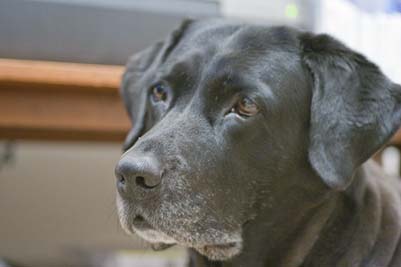
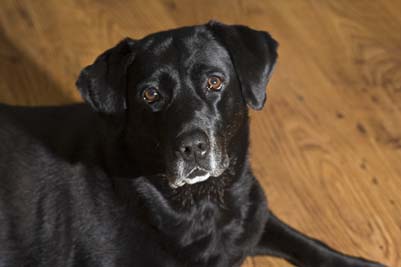
I got called out on a computer task today, so got home late to a limping Labrador. My poor little pup (she’s 8 years now, but I got her at 8 weeks, so you know what I mean) was limping rather heavily and favoring one paw – she has such a forlorn look in her eyes I almost get the sense that she is crying (is it possible for dogs to cry?). Needless to say, my mind has been on some other things today. If she’s not doing better tomorrow, it’s off to the vet I go. I think she might have walked through some glass inadvertently when my wife took her for her afternoon walk while I was out.

Another fun day in the life, eh? Anyway, in light of the events of the day, I feel compelled to make a declaration that this a “Moo”nday, not a Monday (her name is Maggie, so we affectionately have called her many derivations of that, the most common of which is “Moo”). So, pardon the non-photo themed day, but I would like to share a few posts of her in kind of a tribute to the best friend I’ve ever had:

It looks like the tutorial might be pushed back a day or two. In the meantime, what does everyone think of the new Lightbox plugin I have in place for WordPress?  (Hint:  Click on an image in the post…)  Until next time:  happy shooting and watch those apertures!! 🙂

Workflow – ACR vs DNG which way to go?

Recently two of the blogs that I read brought some meaningful insight on individual work flow perspectives. The first was Scott Kelby’s Photoshop Insider, where he had a few people criticize his critique of camera raw in Photoshop CS3, Lightroom, and Bridge. It was a pretty good and informative post, but a select few saw that as an opportunity to say that he was not giving Apple’s Aperture a fair shake. He actually replied to the comments (which he normally doesn’t do), and with quite an effective argument. This was quite the departure from his normal style, where he has just a few things to say and they are punctuated by pictures, as he likes the visual aids. The ultimate point though, was that Scott is very much a fan of the Adobe Camera Raw in his work flow and post processing of prints.

The other was Mike Johnston’s The Online Photographer. TOP is a great blog if you like to read, but is not very often written with the visual learner or “reader” in mind. The post that struck me was Mike’s Friday post, where he espouses “What to Buy” and his thoughts on the DNG format. While quite interesting, it’s not exactly in keeping with my thoughts on post processing.

Since I am more of an ACR guy than a DNG guy, it’s really going to be beside the point to discuss my feelings on work flow and post processing. Instead I am goig to take a different tack here and say that work flow is really up o whatever works best for the individual. I know some people that go with open sourced options like GIMP, and that is equally viable if the results are acceptable to the photographer. It’s ultimately a matter of this – opinion!

All of this brings me to my final point, and that is really about the nature of blogging itself. Blogging, as much as we like to think otherwise at times, is just our personal opinions. I think sometimes we get wrapped up in promoting certain ends, and I am equally guilty of that here at CB – I promote my own photography, ideals that I believe in, and software and hardware that I use. Nevertheless, it is, after all, just my opinion.

So, partly in response to those that started giving Scott K. a hard time, and in defense of Mike’s DNG work flow with the Pentax – lest we begin to take ourselves or others begin to take us too seriously, we are all just promoting our own opinions on subjects related to photography. It’s definitely useful though as different thoughts and opinions and ideas are what inspires each and every one of us to new levels of creativity and original thoughts. So, my hats off to all the blogging world, but this weekend, most especially to Scott K. and Mike J. for being on the leading edge of the topical content for photography.

In closing, I’d like to open the comment section up for others to share their thoughts and opinions on work flow, and blogging in general if you like. What work flow style do you prefer? Do you act on the recommendations of fellow bloggers, fellow photographers, or on other resources? Don’t forget to get out and shoot too though, so happy shooting and watch those apertures!

In the spirit of keeping things light-heartedly, and as a “make-up” for the short post yesterday, here’s the weekly best from What the Duck!

What the DUck - Friday, April 25th