Lame teaser alert, but that’s the title for the podcast over at Learning Digital Photography. Make sure to stop over to the podcast and download the show today! Here’s the show notes (I may add to these as I remember link references – if any are missing, let me know in the comments so I can be sure to add them…)
The last day to enter your photos for the Lightroom giveaway is super close – so get your shots in the Flickr thread here pretty soon!
Adobe updated the ACR to 5.4 (still in beta), and is downloadable here
Canon announced some firmware updates and break/fix news on some of its SLR lines. Tune into the podcast for details.
Seriously folks, don’t miss out on your chance for a free copy of Adobe Photoshop Lightroom! Get your photos in today! A $30o retail value and free from the folks over at Adobe – in this economy we could all use a little help and Adobe is being very generous here.
Well, that’s about all for this week. Thanks for tuning in and we’ll see you back here on Monday – as we head out for the weekend, don’t forget to have fun out there. With that in mind, here’s my favorite WTD from this past week – so fitting for my job in IT!
Happy Shooting!
ETA: Thanks to reader Don for reminding me about the link to the PhotographyBB magazine article. You can download the full magazine here
One of the more popular posts here on the blog has been two that consisted of explanations on how to bracket multiple exposures in camera in order to capture a wider range of exposure values than is typically permitted in a single frame. Typically, these various exposures are then seamed together in some editor like Photoshop, Photomatix or other that is available to produce an effect called HDR – high dynamic range. You can get some impressive results with various techniques that appeal to different subjective perspectives.
Here at the blog though, rather than take sides on such post processing methods, it’s more fun to show people how to do things, and then let you all take your own liberties either with the approach or with your processing afterward, or both to get results that appeal to you! With that in mind, the feedback I’ve received from the previous discussions included a large number of people that asked for visuals of the process (I guess they are all visual learners).
Well, rather than take several dozens of images showing all the various settings and then explaining how I got toeach, a video seemed a more appropriate approach. So, here’s the video short for those of you that requested visual aids. It’s not the most professional but you should be able to get the gist.
This would also be a good time to remind everyone that we are in the dwindling days of the Adobe Lightroom contest. You can win your own free copy of Adobe Photoshop Lightroom, courtesy of the folks at Adobe, simply by entering images you’ve taken in May over at the LDP Flickr thread. Limit two images per person, but there’s still room for many more entries (no limit on the number of PEOPLE that can participate!) just join the group for free and post your images. Good luck to all and may the best photo win! (Final results will be posted in June – I’l send my top ten picks back to Tom Hogarty for final judging when he’ll pick the winner!)
That’s it for today – I should have the podcast up tomorrow, but as always, no promises as my schedule has been fluctuating at work lately. Happy shooting, and I will be back with more news, information, insights, tips and tricks tomorrow, whether in written or audio form. Thanks for tuning in and we’ll see you back here again tomorrow!
Interview of Tom Hogarty over at Adobe, to the generous donation of a copy of Photoshop Lightroom for a contest (only two days left!)
A 3 minute clip on The Tech Guy Radio Talk show with Leo Laporte
Invitation to go on a photo shoot with Scott Kelby, followed up by dinner with the crew
Front row seat at Lightroom Seminar
A very kind and thoughtful mention on Scott’s blog only yesterday
And now…
Well, I don’t want to jinx it, so I am going to have to leave one of my tricks still in the bag until things get firmed up. Suffice to say, if it comes to pass (and I am still not holding my breath)… this will be a very cool thing for the readers of the blog, listeners of the podcast, feeders of the…well, all of it!
So, for the time being, here’s a few other photo tips to help you improve your composition when out shooting:
Keep a quart sized resealableplastic bag with you. Fill with sand or dirt on location for a quick and dirty beanbag support for the camera. Empty when done and toss it back in your bag!
Got a monopod with you? Attach your camera, set the timer and hold it out facing down (or up, to the right or left) for a new and interesting angle.
Need a quick gauge on how much time until sundown? Hold your hand out at arm length and count the number of fists between the horizon and the sun – each fist = 1 hour!
Carry a small sample of sticky putty with you to immobilize objects for capture – great because you can use it over and over again and it won’t leave marks on gear or portrait subjects in tabletop environments.
Wear cargo pants – that way you can walk with one lens on your camera, another in a leg pocket, and other accessories in the other side (media, spare batteries, business cards, etc) for easy on-the-go access to your two favorite lenses. This works for lenses up to the 200mm range, depending on your height and the cargo pocket size), thus keeping your hands free to shoot and interact, while also not being saddled with a heavy backpack or slingback (you can now carry a Camelbak to keep hydrated!)
Got your own tips and tricks to help photographers on the go? Share them in the comments or with me via email. Remember, the Adobe Lightroom Contest Giveaway only has three days left including today, so get your photos in over at the Flickr group here!
This first day after a long Memorial weekend, things are a little slow out of the starting gate, but as luck would have it, slow and steady is the theme for today, because my gear review that I postponed from yesterday is none other than the trusty tripod!
The tripod is probably one of the most basic and easy-to-understand pieces of equipment in a photographer’s gear bag – yet likely one of the least used. I can’t tell you the number of times (myself included) I have heard someone utter “Argh! I left my tripod back in my car!” We’ve all done it, so the question becomes one of how to ensure you take the tripod with you. The answer lies in making the right investment the first time.
FOr me, the first investment (because we all invariably try this route first), was a cheap an economical one from Wal-Mart for roughly $20. I was quickly disavowed of its ability to support even a Canon XT with a 70-200 lens on it. I went so far as to weigh down the plastic center column with my gear bag to little avail. It was just not built for my gear. Perhaps such a tripod would be good for the P&S crowd, because I would rather not disparage any gear intended to provide an increase in stability.
Anyone who goes to any length to increase their camera stability recognizes the benefit of a tripod. So many pictures out there can benefit from increased stability – yet they continue to pepper the internet in perpetuity. So, if you really are strapped for cash – something is better than nothing. But, if you would like to invest a little in “some legs” (parlance for a tripod among photog-types apparently), then take a look at Bogen/Manfrotto.
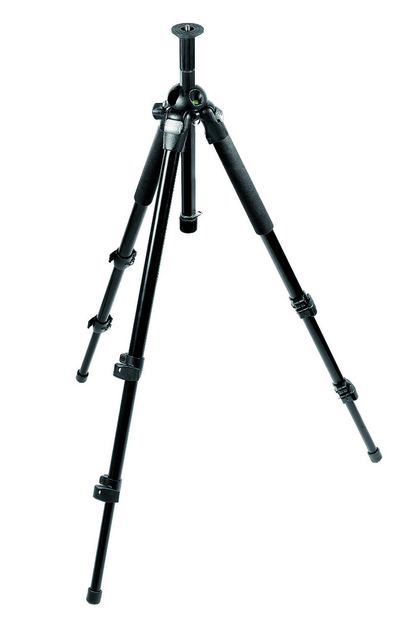
Bogen/Manfrotto gear is recognized as one of the industry leaders in tripods, monopods, and camera equipment. Another serious name in the game is Gitzo, and I’ve heard good things about them too – but for my money, I went with Bogen a few years back in my pursuit of stability. My choice? The Bogen 3021BPro:
This set is really sturdy – made of aluminum and an extended eight of nearly 70″ (69.29 technically), this was a great investment for me. I stand at 6’1″ (73″) so the height appeal was a major contributing factor. Cost-wise, it also came in within my range at roughly $150-$200 new. With quick-clamp leg extensions, and the ability to set up at varying ranges of 25°, 43°, 73° and 90° it was a great investment for me.
With the stability and low price though, came a downside – weight. The legs themselves weigh in at a little over 5 lbs, but I did not plan on being very mobile with the set. So, it was a great starter set for me. The reason why I said “set” though is because any good tripod also needs a good head. You’ll notice from the inserted image that the legs have a lonely screwmount at the top. This does not give you much mobility for the camera when attached, so you really need to also invest in a head.
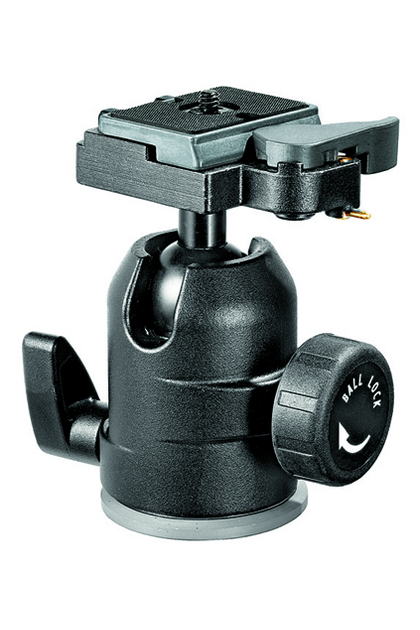
The head attaches to the tripod, and then in turn attaches to your camera and allows you a little more flexibility in moving the camera position around to get the right angle on your shot. There are many types of heads including trigger mounts, ball heads, and pan-and-tilt heads. Rather than get into an extensive discussion of the various heads as well, here it’s sufficient to say I chose the ballhead route. Specifically, I went with the Bogen 488RC2.
This is super nice because it allows you to pivot your camera around very easy and go from landscape to portrait mode in a snap. Also nice is the fact that the head comes with a quick-release plate, basically allowing you to go mobile from your stationary tripod in a snap. I’ll go into the various heads and how they work in some future post. For here though, I got the ehad at about $120, so for less than $300 total, I had a pretty decent workhorse for a tripod/head set. Here again, the only downside I can think of is weight. The head also weighs in at 1.5 lbs so I am getting near 7 lbs of tripod weight total. It doesn’t sound like much, but if you’ve tried lugging a tripod/head combo around on a photowalk, it can get pretty heavy pretty quick if you don’t have some strapped method for carrying it while walking or traveling. For the most part though, it’s lasted me well and worked gloriously – when I remember to take it out of my car!
Eventually I will probably either upgrade this set of legs to the more lightweight, yet also sturdy, carbon fiber material that is becoming more cost effective. At the time when I got this set, carbon fiber was very new on the scene, and thus very expensive. As we see the presence of carbon fiber increase in the market place, the price has also come down some. Not a lot, but enough for me to start considering it. In all likelihood, I could see myself hanging on to this set for studio or location work while also adding to the gear bag with the more lightweight carbon fiber legs for on-the-go types of photography.
All in all though – if you don’t have a set of legs, this would be an excellent starter set. For under $300 your pictures will undoubtedly see marked improvement – that’s assuming of course you don’t forget the gear in your car! Happy shooting all and we’ll see you back here again tomorrow!
Nothing says it better than this – thanks Scott, to all our active troops, and all the fallen ones before that paid the ultimate price for our country:
After yesterday’s post to Youtube of my photo walk with Scott Kelby, and the fact that I mentioned that it was created first in Lightroom – I’ve gotten many emails asking me how I created it. The answer was quite simple – if you own a Mac. Here’s how you can export Lightroom slideshows to the web is less than twenty steps:
Create your slideshow as you normally do in Lightroom.
Export the show to jpg files in a folder of your choosing.
Close Lightrooom
Open Garage Band
Mix a track of audio music that will fit the theme of your slideshow
Export that audio track to the folder with the pictures.
Close Garage Band
Open Photoshop CS3 (or your favorite pixel based image editor)
Create an intro and closing image for your slideshow and save as jpgs to the folder
*Hint* Make sure you keep the dimensions consistent with your previous images so you don’t get pixelation
Close Photoshop
Open iPhoto
Import the photos from the folder you created earlier with the jpgs to a new album
Create a slide show from said album
Rehearse timings and check for image/audio quality
Export to desktop (it will export as a Quicktime movie file by default)
Take said movie file and upload to YouTube
Add titles, descriptions as needed…
Voila!
The key to this is iPhoto. You don’t necessarily need Garage Band to make a legal audio track. Many open sourced audio files are available for use, though a lot of that content is classical. iPhoto has the built in ability to export slideshows as a movie than other applications like Lightroom, Powerpoint, Photoshop, and others. Lightroom is also rather key too though as the backgrounds and text effects for the titles and everything were done in there.
On Windows, it’s a whole different story – you can do the Lightroom thing, but then you have to go out and buy a slideshow program to accomplish this for you. While there are many options, and at varying levels of price entry, the ones that I’ve used that are good are Proshow Gold and Camtasia, from Photodex and Techsmith respectively. The former prices out at $80 while the latter runs for a pricey $299 but allows you to also do screen captures, and lots of other stuff. Either way, shelling out additional money to do something that is native on the Mac gives just another reason to consider the bundled functionality that Apple brings to the table with it’s computer lines. (And this is coming from someone who has worked in Windows almost exclusively for the better part of ten years… as I tell people these days though, I work in Windows and play on my Mac!)
Finally, as we head into the weekend, there’s a couple fellow photographer/blogger types that are hosting contests and seminars in the upcoming weeks and months. So, if you’re interested in improving your craft, there’s no better way than to either participate in a seminar and learn something new, or submit to a juried contest…and that’s just what Rob Jones of Towner Jones Photography is doing and Scott Eccleston, of Weekly Photo Tips! Rob is hosting an impressive summer photo contest, and Scott is runing a Maine Photography Workshop that is sure to ignite the creative energies. Act soon on Scott’s as registration is almost over! Make sure you take these guys into consideration when planning out your summer activities!
That’s it for this week – I am off Monday for the holiday, so there may not be a blog post then. Next week is the last week for the Lightroom giveaway contest though, so be sure you are getting your entries in to the Flickr page to win your own free copy of Adobe Photoshop Lightroom – a $300 value! Happy shooting and we’ll see you back here on either Monday or Tuesday!
So, as many of you know, Scott Kelby, president of the National Association of Photoshop Professionals (NAPP), Kelby Media Group, Kelby Training Live, and leader of the pack of Photoshop guys over at Photoshop User TV, was in Denver yesterday on his Adobe Photoshop Lightroom tour. He led a seminar yesterday that, despite several technical difficulties, was pretty rockin’ when it comes to establishing a work flow in Lightroom.
Scott is also known for his annual worldwide photo walks that he started last year. This year response has just been enormous to the walks, with several cities (including Denver) filling up within the first 24 hours. Well, on his blog this last Monday, he wrote a Q&A post describing the photo walks, what they are, how they work, and all that stuff. One question he snuck in though was that he would be in Denver and did anyone know of any good places to shoot in the downtown area.
Since I work downtown, (pretty close to the Convention Center I might add), I have a fairly good understanding of where things are, and what’s fun to shoot. So, I posted a comment on his blog of where he could go and what might be fun. To my astonishment, he actually wrote me back via email, asing if I’d be interested in going on a photo shoot with him to kinda show him around! Not give him a few locations, not recommend a restaurant – he invited me on a photo shoot! With him! My jaw about hit the floor, but I did respond that it’d be my pleasure to show him around the area. He sent me some info on where he’d be staying and to come on over after work on Tuesday! My jaw hit the floor again. But, regaining my composure, on Tuesday after work, I walked over to his hotel to meet him. Knocked on the door and sure enough – Mr K. himself! The maker of the Kelby Kool-Ade!
For the next 2 hours, we walked around the downtown area – talking shop, and all that stuff. I was silent for about the first 30 minutes, afraid I would say something utterly stupid to embarrass myself, but as I walked and we talked, found that he’s just a regular guy (despite his amazing base of knowledge, and…well, the fact that he’s Scott Kelby!) After a few hours of shooting, I then enjoyed an amazing dinner with him and his crew – names like Bert, Ben, Moose, Matt, Corey, etc., etc., were bandied about in the regular conversation. Needless to say, I kept quiet for most of it, trying to keep my jaw off the floor. I know, I know – they are all people too, but every time someone’s name was mentioned, I just kept thinking to myself, “Yup, I read their blog too!” Oh, and then for the next day’s seminar – he reserved a front row seat for me! It was an incredible day, and I just wanted to take a day here on the blog to give a nod to Scott for being so open and friendly, and just – so, well….cool!
My shots from the day were pretty much lousy as I totally wasn’t paying attention to my technique or anything – just trying not to look like an idiot. Nevertheless, in honor of his visit to Denver, and in hopes of his return:
There are so many tricks and little tips to taking better photos – it often seems like millions, doesn’t it? Well, it does to me. I thought of one last night that thought the listening audience might enjoy. This one is a toughie though (because it’s not that easy to do)…are you ready? here goes:
Shoot for fun
Yep, that’s it. I say it’s tough because we can often forget about the fun factor. We get caught up in the gear, the software, rules of composition, ISO’s shutters, apertures, marketing, advertising, booking gigs, constantly on the go, and all that stuff.
Last night I went out shooting with a buddy in downtown Denver – he’s only in town for a couple days, so didn’t have a lot of time. It was a last minute thing too, so not like I had time to do any major set up or preparation. Instead, we walked the 16th street mall – I showed him a slice of life in downtown Denver. We saw some street musicians and other performers, hit some of the tourist sites like the Performing Arts Center, Denver Post Building, etc., etc., etc. This is all stuff I’d seen before (and taken shots of before).
The difference last night? I was just out with a friend, shooting the breeze, talking about photography, laughing and joking around, then we grabbed a bite over at Maggiano’s, a great local Italian restaurant. It wasn’t all about the photography though – we were just having fun. Yet, we both got some photography in there too, because we’re both photography enthusiasts. (Well, I am an enthusiast, he’s a professional – his career deals a lot with photography, so he knows a bit more about it and does a great deal more.) We were just out having fun. And we (or at least I) had a blast!
Plus, he gave me a few pointers, so that’s always a good thing – to learn a little while having fun. But without the fun, the experience just isn’t the same. So, if you want a little secret to taking great shots – make sure you are having fun! If you’re having fun, you are more relaxed, and can go with the flow, letting creativity and inspiration come to you. I know I had a lot of fun, and some creative moments came out of our outing last night. So, to the rest of you – make sure you shoot for fun every once and a while – it can really help energize you! I’ll try to get a gallery of shots together for posting later – but until then, just keep on shooting. Thanks for stopping in and we’ll see you back here tomorrow!
Ever since Tom Hogarty came on the podcast and I’ve had some time to dive into Lightroom, I am thinking more and more that this is a much better solution for managing all of my photo assets. Since I’ve found myself spending more time in LR and less time in PS CS3 (Extended), I started debating if I really needed so much horsepower under the hood. After all, CS3 Extended is quite the workhorse, from performance, to functionality, to footprint, and of course, price. It left me wondering about my upgrade path.
In all honesty though, I think the term “upgrade” may be a misnomer – after all, am I really using all the features of the full version of Photoshop Cs3? If not, what’s the point in upgrading? Perhaps I should be looking at a downgrade. After all, I really do spend less time post processing these days. So, what are the differences between CS3 and this thing called Elements? Well, for the loyal readers of this blog, I decided to find out.
First up, I downloaded a trial version of Elements 7.0 from Adobe’s website. The download is about half the size of the Photoshop Cs4 download (400+ MB for Windows Elements, and over 800 MB for Photoshop Creative Suite on Windows). To the geek in me, that means a smaller footprint on my hard drive, and less consumption of system resources. Something to consider…
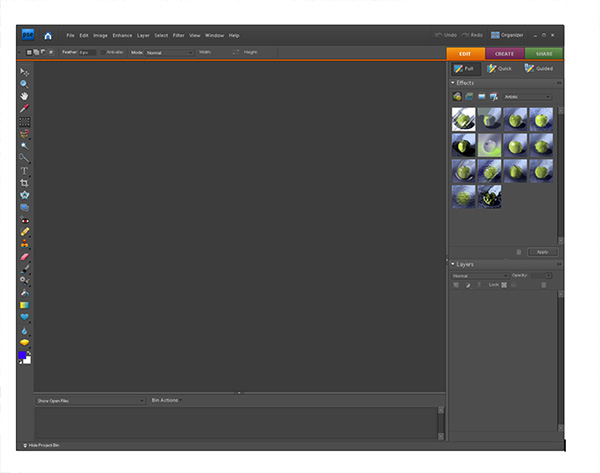
Anyway, I decided to really do a side by side comparison, and loaded CS3 and Elements in their default work spaces, then compared notes. Here’s what I found (CS3 is first, Elements is second):
Photoshop CS3 Default WorkspaceDefault Elements Workspace
Wow! Quite a difference. I first noticed the much darker color of the work space for Elements. Not that big a deal in the grand scheme of things, but something that I would necessarily have to adjust to. So, what else is there? Well, rather than go over each painstaking difference of the two applications, I decided to just give a quick overview here. And, with the quick overview, I figured the best place to start would be the toolbars, since that’s what we really need to use in either of these anyway, right? So, let’s look at them side-by-side:
Photoshop CS3 Extended ToolbarPhotoshop Elements Toolbar
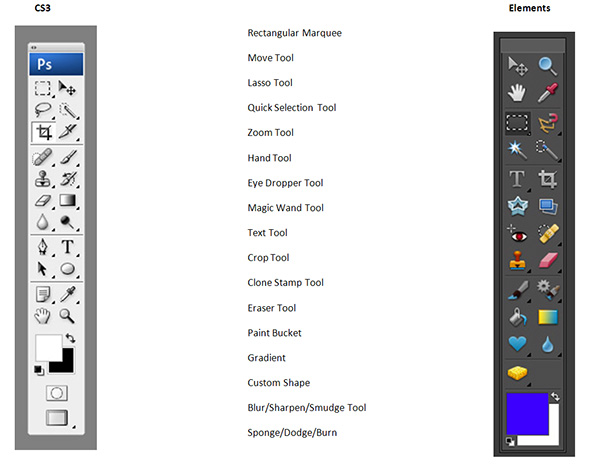
They actually don’t look too diferent when you look at them side by side, do they? I didn’t think so, and I set out to count the various tool bars. Know what? On a quick overview of the 22 tools in CS3, I counted 17 commonalities between CS3 and Elements 7! That’s a lot of overlap! Are there more buried tools in CS3? Most likely. On quick count, I found 60 tools throughout the CS3 Toolbar. In elements, 48! Even still, not a lot extra. From a percentage perspective, that is 20% additional functionality in CS3 Extended versus Elements 7.0 My guess is CS3 Regular would have less of a difference still.
The question is though – how often do you go searching for some buried tool in CS3? As a photographer, in all honesty, not that often. If you think about it, as photographers, we crop, re-size, perhaps straighten an occasional horizon, add some sharpening, and if we want to get really serious with a photo, we’ll do some dodging and burning. All of these functions are present in Elements 7.0
So, why would you want to go with the CS3 or CS4 version of Photoshop – truly if you want to take your photos to the Nth degree, or do serious work like graphic design, web design, or photo restoration, I can totally see the need for some of the more advanced tools in the Creative Suite. But more and more, I find myself using CS3 less and less. Take a look at the commonalities listed below – these are identical features in both applications! It took me a little by surprise when I noticed the similarities even in tool names. See if you can find the common tools from the listing below:
Common Tools between CS3 and Elements
So, what other important factors go into an image editing program for me? Well, having been working in the Creative Suite for a long time – I do enjoy the benefits of layered files for different purposes. Well, guess what – Elements does that too! That means you can edit and save files as PSD’s!
I also like using actions to automate my work flow. Uh Oh…from my initial glance, it does not appear that Elements 7.0 has this functionality built in. But, can it be added? Well, a Google search on the topic of “Elements Actions” says yes, so I think I could probably figure it out enough to eek the process to my needs.
The other major functionality I have an interest in is the ability to edit and manage raw files from my camera. Can I see the raw files? Sure enough, the ACR converter has made its way into Elements as well!
Adobe Camera Raw Converter in Elements
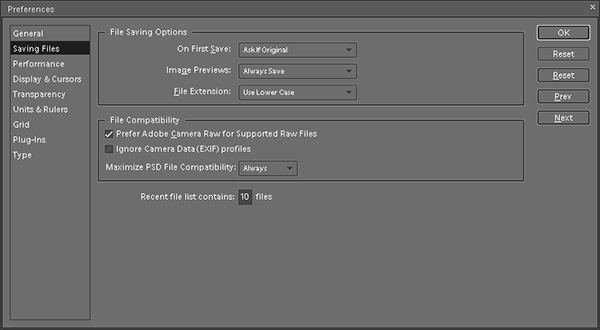
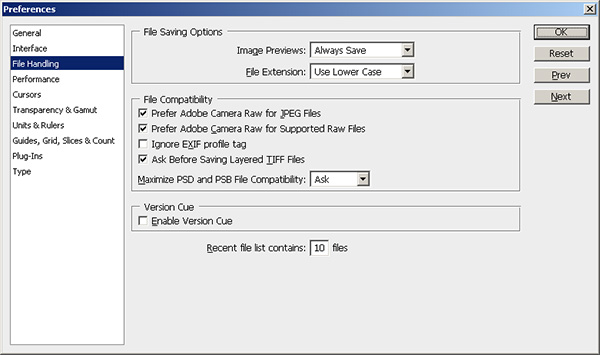
In fact, a lot of the preferences settings seem to have migrated over from Photoshop CS3…look at the same screen from there:
Photoshop CS3 Preferences Settings
As similarities continue to mount, the last major thing to consider is price. Retail, CS4 runs at $700 for the full price, an upgrade runs $200. Elements? Well, I think y’all know where this is headed: Retail $139 and upgrade for $119. I don’t know about you, but that is a HUGE cost savings. It almost seems too good to be true, and given my penchant for not taking things at face value – I will take a look at the image processing capabilities in greater detail next week. We’ll take a look at noise handling, speed, performance, and see how it does with a variety of images from my Canon 40D.
The biggest downside that I can see is that you don’t have the color management capabilities in Elements that you have in the Creative Suite – I like making some LAB adjustments from time to time, and filters may suffer in availability too – but more on that next week.
For the time being though, given the similarity in apparent functionality, the reduced price for Elements, and the proportionate footprint on my computer – Elements is definitely a contender. For all I know – as I learn more about Lightroom after the workshop from Scott Kelby and NAPP on Wednesday, the idea of a separate application for image editing may go by the wayside too, especially when the cost for the CS product is 400% that of Elements.
So, what do you think? Anyone out there using Elements? Any other downgraders care to share their thoughts? Have you enjoyed downsizing? Found things you missed? Workarounds? Add-ons? Tell me more as I continue to explore Elements next week – I’ll add reader observations there too! In the meantime, happy shooting, and we’ll see you back here tomorrow after the NAPP workshop!
In keeping with the last few weeks of hardware reviews, I am taking a look in my own bag one more time to bring you this weeks’ hardware review: the 70-200mm L lens from Canon. Canon has several variants on this lens, with different minimal apertures both with and without Image Stabilization (IS). So, in the interests of full disclosure, this is a non-IS lens, and the aperture range is the standard one, 4.0 to 5.6. So, with that distinction being made, we’re off and running:
Canon's 70-200mm f4.0 lens
The “L” distinction is one that bears discussion right off – Canon only gives this out to lenses that it deems have superior optics – which means a wider range for it’s sweet spot, tack sharp focus, and better sealing against the elements. This naturally means that this lens will, by definition and categorization, be sharper than a comparable “non-L” lens. However, for this particular range of zoom, Canon doesn’t make a non-L lens, so one would have to make a comparison with a 3rd party brand such as Sigma or Tamron. Even there though, comparisons are tricky primarily because vendors are moving toward faster glass (in the 2.8 category) and IS features.
In that regard, the 70-200 f4.0 really is in a class by itself. As a result of its unique status in the field of available lenses, comparisons are rather arbitrary as no other lens out there has the same specs. Rather than making those comparisons though, I’ll just say that this lens does deliver superior performance for its’ category.
So, how is this a review? Well, it’s not just a question of performance, it’s also a question of price. Anything can be stellar, but whether it’s worth the price is another story. I know of luxury cars that exceed 6 figures for their cost, however, most cannot justify the expense, either because of their financial situation or the expected need. So, how does the 70-200 fit when it comes to cost? Pretty well actually.
The cost for this lens at B&H Photo is $600 right now (technically $599.95) after a $50 rebate. Considering the next step up is twice the price for either an f2.8 or an IS lens, this is actually a steal! I was able to find mine second hand from a fellow photographer when I lived in SC, so got it for considerably less. Included in my package was a lens hood, and a collar for mounting to a tripod (which I definitely would recommend given the weight). The previous owner was also nice enough to leave the Tiffen filter on it that provided protection for the lens. All told, the lens and accessories would run around $700 for the lens, lens hood, UV filter, and tripod collar.
When looking at comparable other lenses from Canon, this is where you really see the bang for the buck. Take a look at the most recent prices from B&H for similar lenses:
70-200L f2.8 = $1250
70-200L f2.8 IS = $1600
70-200L f4.0 IS = $1025
So, you can save at least $425 if IS isn’t important to you, or $650 for the next fastest version of this lens
At a smidge over 1.5 lbs, the weight does balance the mid-grade SLR’s quite nicely, although on the Rebel line I recall it being a tad heavy. As a general rule of thumb, with larger and heavier lenses, you’ll want to carry this by the lens itself rather than the camera as you don’t want to put undue tension on the mount.
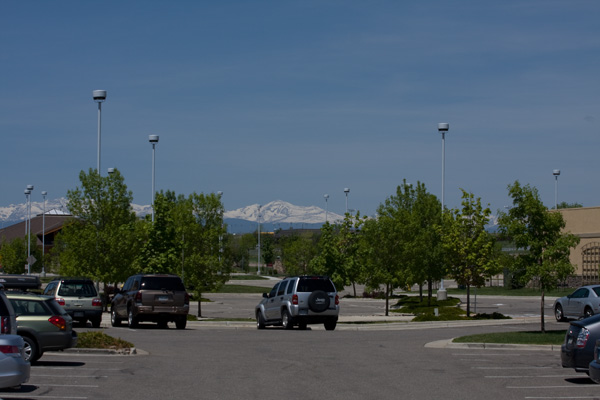
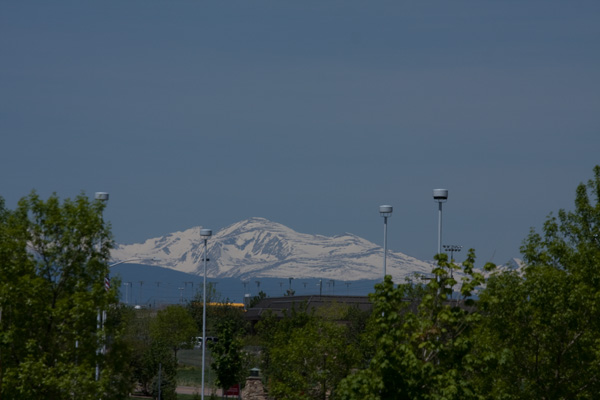
Overall though, for the price and range, I would highly recommend this lens. It’s tack sharp at both 70 and at 200 with a sweet spot ranging from f5.6 to f16. Kind of hard to say no to that kind of quality when it’s offered at such an affordable price. Here’s some sample shots to show what I’m talking about:
Here’s a sample from 70mm at f9.0
The Rocky Mountainsfrom a distance
And the same scene from 200mm at the same aperture:
The Rocky Mountains
Then, just to give you an idea of the sharpness, here’s some shots at f4.0 (a little noiser because I was at ISO 3200)…first the 70mm shot:
What time is it?
And now at 200mm:
What time is it?
And the 200mm shot:
Okay, so that’s about it for the day. Hope you found it useful and informative (as always). Don’t forget the Lightroom Contest going on over at the Flickr Thread – only about 12 more days left and still not a lot of entries. Great chance to win a free copy of Adobe Photoshop Lightroom (retails for $300)! If you have ideas, suggestions, comments, feedback or other insights on future gear you’d like reviewed, feel free to share those in the comments below or with me via email.
One last little nugget to share today…Scott Kelby announced his 2nd Annual Photowalk early this morning, so be sure to register in your city. I’m already registered in the Denver group and that’s rolling early (7:45ish am) in the Lodo area. More details to come on route, eating place, etc. , but mark your calendars now for July 18th! Here’s the link for more info if you’re not in Denver: Worldwide Photowalk Have a great day, Happy Shooting, and we’ll see you back here again tomorrow!