Some assembly required

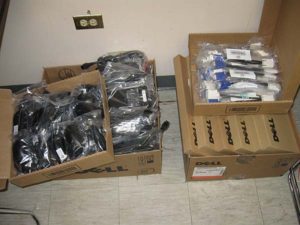
As promised from yesterday, here is the assembly line of computes I unboxed:

img_00071

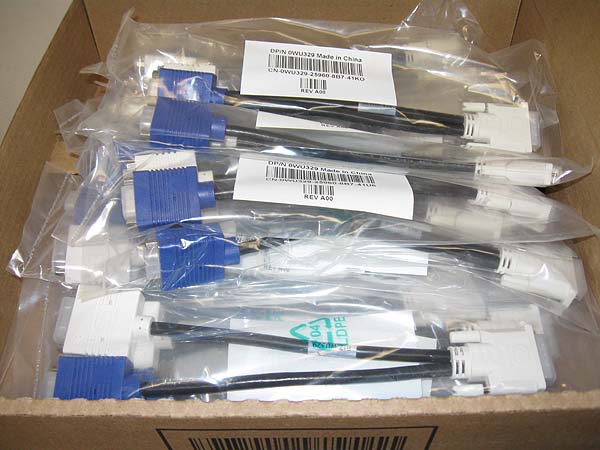
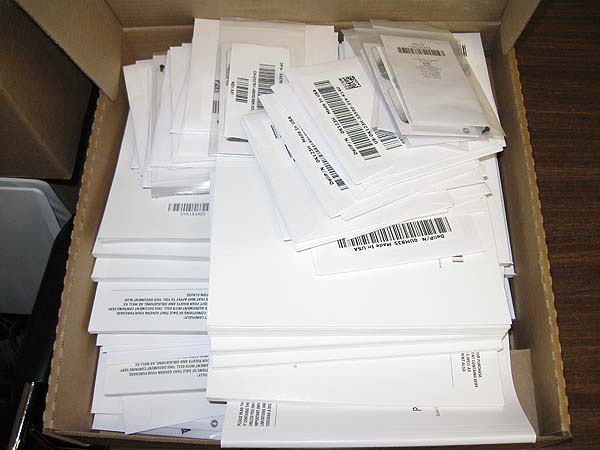
And then here’s the boxes that I consolidated all the accouterments into:

img_0011

img_0009

img_0012

Thankfully, the laptops didn’t come in today, so we had a brief respite.  Monday’s gonna be fun though!  I think I am going to try and enjoy this weekend!  You be sure to do the same.  Happy shooting and we’ll see you back here again on Monday.

Unboxing strategies…

The folks over at This Week in Photography (aka TWIP) had a post earlier this week that gave a suggested checklist to follow when unboxing new gear.  As you all know how much a fan of checklists I am, I started giving this some thought about what sort of unboxing strategy would work best in my own patterns of gear management and setup.

Then toda at work, we got in 23 new computers.  This means we now have:

  • 23 CPU’s
  • 23 Monitors
  • 23 keyboards
  • 23 mice
  • 23 VGA cables
  • 23 USB cables
  • 23 power adaptors
  • 46 power cords (one each for the computer and monitor)
  • and 46 boxes (one each for the computer and monitor)
  • 23 Reinstallation CDs
  • 23 Owners Manuals

We needed a strategy!  So, we opened three of the boxes, took all the acouterments out.   With three boxes now empty, keyboards began piling up in one, power cables and adaptors in another, then mice and VGA cables in the third.  It became an assembly line of sorts.  Thank God we had a tech room to sort it all out.  By the end of the day, all but the first three boxes were cleared out.  Tomorrow, the switch will be set up so that these can all be prepped with our standard image over the weekend and we’ll have 23 new happy end users (that’s what computer geeks call everyone else in the world).  Then come the new laptops… *sigh*

I belatedly thought I should have taken a picture of the before, during, and after.  Instead, you’ll just get an end result tomorrow.  (It looks kinda cool after all was said and done!)

The point today though, is that with a checklist and a strategy, you can make pretty much any task go easier.  You will get more consistent results with whatever the task is, and the chances of being able to repeat your results will also increase with practice.  So, make sure you are always practicing your technique, because the same concepts hold true to photography.  Thanks to the good folks over at TWIP for the creative genesis for this post today.  Happy shooting all and we’ll see you back here tomorrow (with pics!).

News and Updates

Just a few little tidbits for everyone today:

The “Name Your Dream Assignment” is in full swing – you can describe your ideal dream photo assignment and with enough votes (it’s entirely a popularity contest) you could win $50,ooo toward actually getting it done!  I did an entry just for the heck of it as well.  If you would like to enter the contest (or vote on my entry, stop over here:  Win a Dream Assignment You’ll probably notice a graphic for it in the sidebar too…

Also, a reminder that the Twitter/Blogging poll I set up a few days back is a month-long poll here, so if you’ve not stopped in to vote and share your thoughts, feel free to do so.  Quick link to the poll is here You can also follow my updates on Twitter here

For those of you that read the comments like I do, you’ll notice that Terry Reinert had some extensive and interesting insights on the bracketing posts I did a short time ago.  He’s got some excellent work over on his own site, so I would highly encourage you to visit.  Here’s the link:  http://www.tkrphoto.com

Kind of a busy day so I’ll leave you with those web links.  If anyone has some useful resources or sites that you’d like to share – feel free to email me or post in the comments section – consider today a web link day and most any post to the comments will be allowed unless it’s blatant spam.  Happy shooting and we’ll see you back here tomorrow!

News, Artists, and Inspiration

Welcome to the show notes for week #17 of Learning Digital Photography.  Here’s the show notes for this week’s podcast…

First off, I’ve done some further tweaking to give a little more consistency and structure to the show for your listening pleasure.  The three segments that I am going to try to regularly stick to will be:

  1. News, Events, and Information from around the community and industry – here I’ll share nuggets, information, and other useful snippets from the most recent days and weeks of activity within the photography community.  Sometimes I’ll share information that’s available elsewhere, and other times I’ll offer my own perspectives on the news and events that shape the industry.
  2. Authors and Artists from within and related to the industry of photography are also an area I would like to devote some time to since the Thursday Thoughts series has not seen much attention lately (not that I am planning to either – I think it’s just on sabbatical!), and I had the good fortune of actually sitting down with an area professional recently which provided a source of inspiration for this weeks show.
  3. Sources of Inspiration – As artists I think we are always searching for and discovering new sources of inspiration.  Often these can come from well known venues such as photography magazines, galleries, and the like, but I am not adverse to featuring unusual or new sources either.  This week, I will be featuring an unusual source of inspiration, so make sure you stop in for this segment too!

To find out why these links are all up and on the blog, make sure to stop over to Personal Life Media and grab this weeks show! For the link grabbers, here you are:

That’s it for today all! Enjoy the show, and we’ll see you back here bright and early tomorrow (well, maybe not so early, as I still have an on-going problem with the sandman! LOL) Happy shooting!

P.S. I am still including a copy of the show locally, so you can grab it from here if you like too. Don’t forget, we still have a poll going on re: Twitter and Blogging, so if you’ve not voted yet, vote here!

[display_podcast]

DST Blues

sleeping

Yep, the ole Spring Forward/Fall back bug bit us this past weekend.  On top of that, a rather late night on Saturday has re-doubled its effect on me today.  Since I am an admitted night owl, the mornings did not afford me the time to put together the blog post for Monday.

So…sports fans, today is officially a bleary-eyed no blog day!  Tune in tomorrow for the (semi) weekly podcast, some photo goodness, and a tweak in the podcast format for even better delivery to the fabulous listeners.  In the meantime… zzzzzzzzzz

Is 12 enough?

An interesting news story came my way today over on CNet where Akira Watanabe, manager of Olympus Imaging’s SLR planning department said that most needs of most people can be met with a 12MP camera.  The full story is here, but does bring what has been an ongoing discussion into a more defined state.  As we’ve seen megapixel counts increase from counts lower than 3 MP less than a decade ago to counts that now are at 12 MP or higher, discussions have arisen throughout the industry on “How much is enough?”

From my perspective, I would agree that 12 is probably close.  Yes, processing capabilities are increasing and hard drive storage space costs continue to decrease at almost ridiculous rates (you can get a 1TB hard drive for around $100 these days!), but these are mitigated by need.  When you look at the true and honest need for most folks (myself included), we do not regularly print much larger than 8×10, or 12×16.  I would venture to guess that even artist gallery prints and portfolios do not exceed 16×20″ dimensions that often.

Yes, more megapixels means you can crop smaller and retain print quality, but at what price?  More grain or noise?  Yep.  Reduced dynamic range?  Yep.  More processing demands?  Yep.  More storage needed?  Yep.  While all of these can be addressed by buying software to handle noise, bracketing exposures to increase dynamic range, and buying more storage to meet the increased demand, there does come a point of diminishing returns on the investment, and Olympus seems to have set that mark at 12 MP.

But, will the market agree?  I think so.  It’s no secret that the economy is not doing so well.  People are likely going to be more frugal in their purchases, and getting that full-sized wall print may not be as high a priority as, perhaps, bread on the table is anymore.  Do we need to re-assess our priorities?  Some say yes, that it’s not all about the megapixels.  Some say we should be asking for things like low light responsiveness, better auto-focusing, faster auto-focusing, better in camera noise handling.  I don’t think any of us would complain either if we saw a decrease in the costs of fast glass.

But who knows – maybe the masses will continue to push for more megapixels.  Now that Olympus has drawn a proverbial line in the sane, will other vendors see the logic and start to taper things off?  Or will the megapixels wars continue indefinitely?  Sure, we can’t predict the future, but guessing and talking about it can be a good source of discussion too because it can get us thinking about what is important in our pictures.  So, what do you think?  Where will things go from here?  Sound off in the comments, and watch for the podcast coming up on Monday where you’ll get an extended version of my thoughts on where things may go from here.

In the meantime, have a great weekend, and go out and getcha some (pictures)!  We’ll see you back here on Monday!

Go soak your gear!

It pays to review your web traffic periodically because I just learned a way that your bathtub can be used for photography!  Not only is it a good place to mellow out after a stressful shoot, but it also makes a heckuva softbox!  I was on a forum that had referenced the blog and a guy had some product that he placed in his tub.  I thought it was an interesting idea, and decided to give it a try.  As it turns out, the tub is a great place to put your gear!  Granted, not to soak it (sorry, but I had to tease the title that way), but to act as a great background and softbox combined in one.

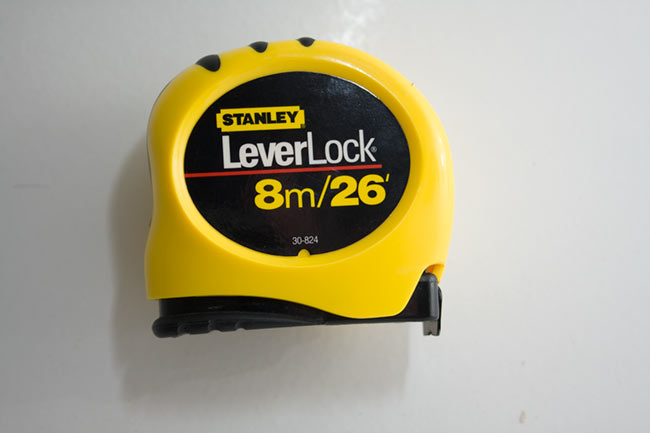
Here’s a few sample shots.  For all the tech-types, these are pretty much straight out of camera (or sooc) – all I did was adjust the WB for Flash and adjust the ACR sharpening from 25 to 75.  All are resized to 650px wide for the blog.  Here’s the setup:  I took the Canon kit lens (18-55) on my 40D, threw on the 550EX, and set everything to default values.  Shutter at standard sync speed of 250, aperture at f8 and ISO at 100.  I powered the 550EX at it’s standard setting, on camera (relax strobists – I can hear you shuddering from here),  and started firing a few shots.  I pointed the flash to camera right and got this:

ruler1

Yup, that’s a God-awful shot, with a nasty shadow.  Perhaps I could ditch the shadow.  Since we’re not exactly using conventional wisdom here, let’s try it with the flash pointed straight at the subject:

ruler2

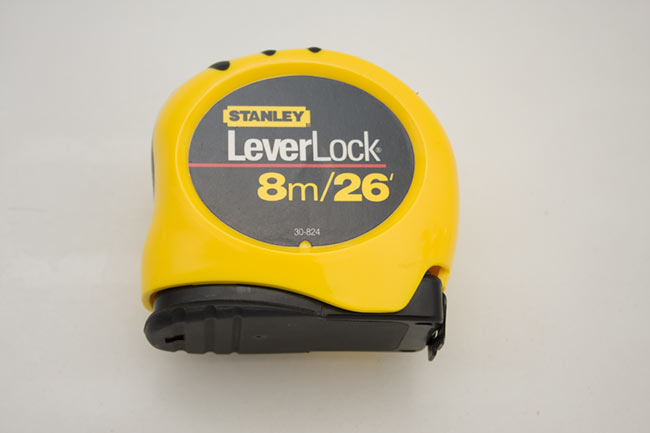
Hey!  That’s actually not too bad.  It’s not that great, and still definitely a “Meh” kind of shot as it’s still got something of a shadow.  So, I spun the flash to fire above me and bounce off the ceiling:

ruler3

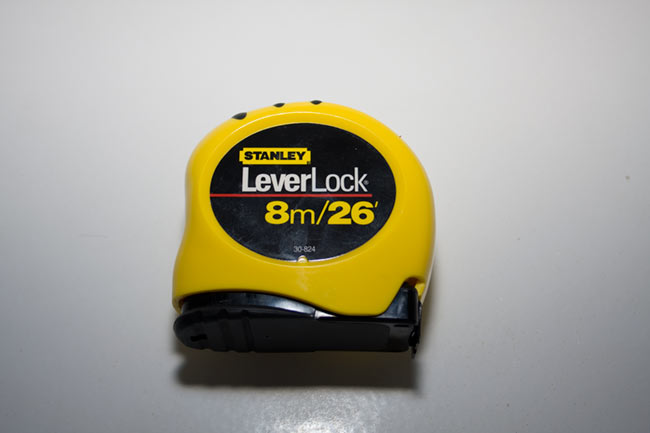
Voila!  You know what?  For being a spur of the moment thing, and without a lot of pre-planning or preparation, that’s not bad at all.  And, it was shot in a bathtub!  Anyone else out there have a bathtub?  Try some shots in it for different items.  I used a tape measure, but what about a pen, or a microphone, or a printer, or even a lens?  I bet you could get some pretty cool results with very little setup!  Anyone else have some odd or unusual ways to get clean backgrounds and even lighting on the cheap?  Feel free to share your thoughts, ideas, and feedback in the comments.  Feel free to link your own efforts there too!  Happy shooting all and we’ll see you back here again tomorrow!

Setting bracketing exposures – shutter priority

As promised yesterday, today I will be talking about bracketing your exposures based on shutter priority.  After a couple comments yesterday that it seemed unusual to bracket on aperture rather than shutter speed, I felt that in this companion post I should acknowledge that, it is.  The reason for the post?  One of the downsides I mentioned is that your depth of field will change considerably from a wide open setting to that of, say, f22.  That can also be an upside though because as you merge bracketed exposures into an HDR image, you can also add depth of field if you make the adjustments in aperture priority over shutter priority.

Additionally, I led off with aperture priority because it’s not the norm, and as most readers will know – I try to approach things from a new perspective when possible.  Finally, as I followed up with in the comments section, the simple fact of the matter was that I could not remember whether 250 or 200 was the absolute middle point for shutter speeds (this is the risk of adding gray above the brain, rather than to the brain! *grin*).  So, I led off with the post where I knew the numbers rote! 🙂

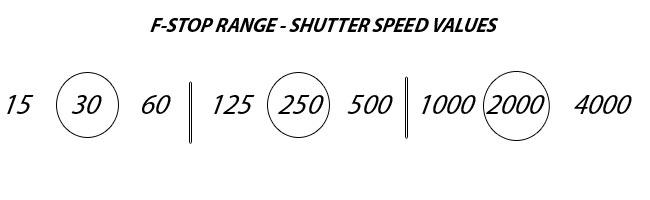
So, in the interests of full disclosure, shutter speed is a more common way to go when making bracketed exposures.  After verifying my numbers in camera, here’s how it breaks down using shutter speed to bracket multiple times:

fstopshutter

I also realized that I did not give the step-by-step yesterday, so here’s the process I would follow:

  1. First, meter the scene, set your camera to ISO 100 and exposure priority and adjust to 1/250th of a second.  Check where your f-stop is.
  2. Second, switch to manual, and adjust all settings to match that metering.
  3. Third, adjust the shutter speed down to 1/30th of a second, and fire off 3 exposures and the camera will bracket over and under one stop.
  4. Fourth, adjust the shutter speed up to 1/250th of a second, and fire off a second set of three exposures (the camera will bracket over and under one stop).
  5. Finally, adjust the shutter speed up to 1/2000th of a second and fire off your last set of three exposures.

Voila!  You now have 9 exposures to merge together for a bracketed workup to take advantage of a high dynamic range, or for exposure blending, as desired.  Of course the same rules from yesterday also apply:

  • Be shooting on a tripod
  • Be using a remote release (or timer)
  • Be using mirror lockup
  • All other settings remain constant
  • and that lighting conditions aren’t changing appreciably
  • You are set to manual focus
  • Your lens is set to its hyperfocal distance

Any final thoughts to share on how to bracket exposures?  Anything I missed or additional tips to share?  Feel free to sound off in the comments section!  In the meantime, Happy Shooting and we’ll see you back here again tomorrow!

Setting bracketing exposures – aperture priority

Over the past few years, I’ve had several people ask me how to set bracketing exposures on camera bodies for multiple exposures.  When I say multiple exposures here, I am talking in excess of 3 shots.  The reason for this is because by default, most Canon cameras (at least all the ones I’ve put my hands on) only have a single over and underexposure allotment on each side of the initial exposure settings.

Let’s take a look at the numbers…say we meter a scene and it says that according to the center point, we should be at f8, with an ISO of 100 and a shutter speed of 250.  So, if we want to expose this multiple times over and under that initial group of settings, since Canon only allows 1 over and 1 under, we will need to make additional adjustments if we want more than the 3 exposure set.

Here’s the entire f-stop range (well, not all of it, but enough for our purposes):

fstop

So, in order to get the full range of exposure, our aperture would need to manually be set to f2.8, f8.0, and then f22 and then let the camera capture the over/under.

For ease of manipulation I always start at the lowest end and work my way up, so in this scenario, I’d start with f2.8, press the shutter 3x, then move up to f8, repeat the shutter press 3x, then finally to f22 and press the shutter 3x.  That would give me a nine stop range of the same image at different exposure settings.  It goes without saying here that in such scenarios, you would want to:

  • Be shooting on a tripod
  • Be using a remote release (or timer)
  • Be using mirror lockup
  • All other settings remain constant
  • and that lighting conditions aren’t changing appreciably
  • You are set to manual focus
  • Your lens is set to its hyperfocal distance

Things that are problematic with bracketing in aperture priority are:

  1. Your depth of field is changing considerably as you move from f2.0 to f32.o so much of what is out of focus at f2 will be considerably sharper at f32 even though you are set at your hyperfocal distance.
  2. Lighting conditions will change.  Unless you are in a studio environment and flash is the only light source, ambient light is constantly changing,and this will have an impact on your exposure values.  Granted if you move quickly and methodically, this can be minimized, but due to the ever-changing values of light, this is something to consider!
  3. Weather conditions will change.  The scene that was perfectly still 30 seconds ago while you did the first bracket may not have perfect stillness for the second bracket set.  Changes in wind speed, direction, and intensity can blur things like flowers, branches, grass, and even some objects that you otherwise would consider fixed.  (Ever see a lamp post in a strong gusty wind?  Or a street traffic signal?)

Any other mechanics, pros and cons or points of discussion I missed here?  Feel free to chime in with your thoughts on bracketing exposures based on apertures.  Don’t forget to tune in tomorrow too for the backeting exposures on shutter speed, along with its pros and cons.  Happy shooting and don’t forget the Twitter v bloging poll from yesterday!  If you’ve already voted, tell a friend!

Monthly Poll – Twitter and Blogging

I was talking with a friend on Twitter last night, and despite the etiquette against chatting back and forth repeatedly, we had quite a lively discussion on the subject of using Twitter to promote/market/advertise your blog. Rather than regale the readership with the discussion, I’ll simply leave the voting unhindered by personal bias, save for one link – a post one of us read on Twitter etiquette a while back: http://tinyurl.com/5lcrqr

With that pretext set, we’d all be interested in hearing the blogosphere thoughts on this subject. So, vote in the poll, then chime in with the comments – the fate of the universe rests in your hands (not really, but join in anyway, it’s fun! 🙂 )

I promise tomorrow I will return to photography topics.  In the meantime, Happy Shooting!