Better luck next time

Heh – I had been so good lately about planning ahead and recording my video podcasts ahead of schedule and just setting a publish time in WordPress, I got on an automatic pilot routine. When that routine got disrupted from some dental and sleep deprivation issues the other day, I didn’t realize until just a short time ago that the post for Friday had not been scheduled. Not only had it not been scheduled – it didn’t even get written yet!

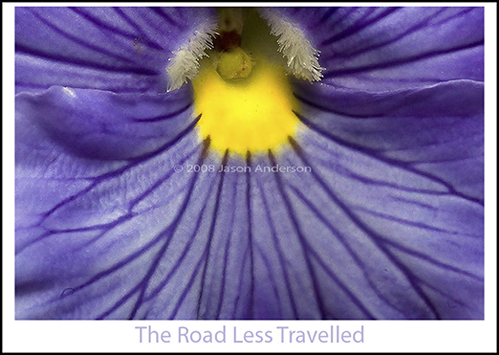
So, a thousand pardons as I rush to get a somewhat photo-related post out before the end of the day. Since it is on short notice, I will simply relay a funny story that happened to me the other day as I was out walking the dog. I had taken the camera and flash with diffuser attached as the day was actually perfect for photography: late afternon, cloudy skies, and evenly light all around. So, I am bouncing along, trying different settings here and there with various subjects – a flower, a reflection in some water, and I have the bright idea to do a macro shot super close on a flower. But, instead of going wide open to get available light, I figured let’s try the flash here – so I pop the flash on, attach the diffuser and set it to ETTL. Then I dial the aperture down as far as I think it can go on the fill flash setting – f22! I pre-focused on the lower third of the frame, then set the focus to manual. Finally, I shifted the camera up just a smidge, knowing that the lower portion would be in focus and because of the f-stop, I would have a pretty solid dof throughout.

Well…there’s always something you forget, and in this instance, it was the ISO setting. You guessed it – 1600! ARGH! Well, I cleaned it up a little with NN after the fact, and yeah, it’s okay, but imagine how this shot would have been without the noise and tack sharp?

Floral Macro

So, it seems another one that got away from me! I think I am going to tape a label to the back of my LCD and write on it in big fat letters ISO! Long story short – always double check your settings, and always take a few shots. I only took the one, so it’s all I had to work from. Oh well…better luck next time! Hee’s your traditional WTD episode for Friday:

What the Duck

Hope everyone has a good weekend. Happy shooting and watch those apertures!

In the News – Doo Wah!

Bop bop doo bop doo bop do wow!  Okay, sorry, that’s a bad skit for the great jazz tune from the ’50’s, but nevertheless, whenever I hear the phrase “in the news” I feel compelled to sing that line.  Now, for your real news from CB today:  I’ve got two stories for you, some news from Adobe on the next iteration of Photoshop and some Canon news on the Canon Hacking Development Kit (aka CHDK) that is now maing waves.  Read on for all the details!

Adobe Photoshop News

Well, the big news I read today during lunch was that the folks at Adobe will be incorporating some sort of GPU support for its next iteration of Photoshop.  Tapping into the GPU (graphics processing unit) means that larger images can be rendered on your display faster.   Another added benefit will be an increase in processing speeds for filters and other intensive activities. Nothing too earth-shattering, except they did report that at the Nvidia show, they watched the presenter zoom and rotate the canvas on a 2 GB image as though it were a 5 MB image.


Canon CHDK News

In more Canon-specific news, I have now read at least 10 articles from a number of resources talking about the Canon Hacking Development Kit (CHDK), which is a free firmware hack that can be applied to P&S grade cameras to allow them to do a number of things that SLR’s do, and even a few that your average SLR can’t do!


  1. The CHDK allows Point-n-Shooters to shoot in raw mode.  The caveat is that since it’s not a standard raw format, you can’t open this in Photoshop or Lightroom directly.  Instead, there is a third party software kit out there (also for free) called dng4ps2 that can convert the image to the more common DNG, which is Adobe’s Digital Negative format.  The DNG file can then be opened in Photoshop or Lightroom.
  2. The CHDK kit enhances the P&S feature set by adding a battery status indicator so you can see how much of a charge you have left on your battery.  I know this feature is already there in SLR cameras, so I guess the P&S’er didn’t have this feature regularly – news to me.
  3. The CHDK kit also adds what they’re calling a zebra mode which will show you whether a picture is under- or over-exposed.  Basically, it sounds like it’s adding a histogram feature.  Again, this feature is standard on most SLR’s, but not on most P&S cameras.  I just think that even a lot of SLR shooters don’t use the histogram (although I would personally encourage more use of it), so adding the feature on P&S cameras may be a little overkill.
  4. Finally, the CHDK kit allows P&S’ers to extend their range of shutter speeds.  The most reliable info I saw for the CHDK claimed the range went from a standard of 1/3200-15 seconds all the way up to a range of 1/33,333 to 65 seconds!  You read that right, that’s one-thirty-three-thousandsth of a second (and change).  Kind of makes the 1/8000ths shutter speed on the 40D look pathetic, eh?  Granted, this was specific to the S5 IS, but the standard change is to 1/64000ths of a second, which is still earth-shatteringly fast! 

Now, the caveats:


  1. Write time slows down considerably when shooting in raw (to about 2-4 seconds – yikes!).
  2. The raw file format is not recognized by mainstream applications like Photoshop and Lightroom.  In other words, file accessibility is likely not reliable.
  3. The software that you have to use to access the raw image data is freeware.  While some software from the open-sourced community is excellent (case in point GIMP, OpenOffice, and many others) and perfectly safe, the fact that this software comes from Russia and is (to my knowledge) untested, sets off red flags all over the place for me.  Of course I work in IT, so it’s in my nature to be suspicious of third party software from third world countries…
  4. As with any firmware hack, this is likely going to void any manufacturer warranty or vendor support for the camera if you install the software.

So, having shown the pros and cons, I’ll leave it to the community – install at your own discretion.  For those that do decide to install, feel free to share your thoughts here in the comments, or with me via email – I’d like to hear feedback on the reliability of the kit.  The CHDK can be downloaded direct from the link here:  http://chdk.wikia.com/wiki/S5IS, and the raw converter from here:  http://dng4ps2.chat.ru/index_en.html  Until next time, happy shooting and watch those apertures (or should I say shutters?)!


Back to Basics – Rule of Thirds Grid

After I recorded and started production on this tutorial my mind began to remember that perhaps I had covered this subject before. I reviewed the subjects I have posted over at the Tutorial Resource Center and did not see it covered there, so figure I am not repeating some tutorial I have already done. Having said that, this is kind of a return to the basics. Continue reading “Back to Basics – Rule of Thirds Grid”

PlayPlay

Quality versus quantity

“Okay, I’m done.”

“That’s it? You’ve only been shooting for ten minutes!”

“Yep, got about 50 shots, I should have 4-6 proofs for you from that bunch.”

“So we’re done?”

“Pretty much…I mean I can keep shooting, but there’s really no point, it’ll just be duplicates of the same stuff.”

This was the dialog I had with a co-worker a short time ago when I went to take pictures of her son for her. It is indicative of a mentality that exists in society…not only is size king, but so is quantity. If you were to take two photographers and set them side by side, who would you think is a better photographer: the one who took 40 shots or the one who took 400? Many of the general public would probably respond by saying the latter, without giving it much thought. Yeah, I took 50 instead of 40, because I have not been a pro shooter for 20 years, so I gave myself a little bit more of a margin for error. Having checked ISO, white balance and histogram settings though, I was pretty confidant that all that was left was composition – so I went with my instinct for what would make a good composition, took 3 or 4 different angles and was done.

Even photographers fall victim to this mentality of delivering a massive quantity of images. I know of several studios that just inundate their clients with hundreds of shots to choose from. They can’t understand why these clients never get any prints or very few prints from the studio. They think that people like to have a choice, and that the more choices you give them, the better. While the idea is not without merit, (because choice is a good thing) it can go to an extreme… and I think that’s where it’s going. The reason why they’re not getting prints done is because too many choices can also be paralyzing. If presented with 4 options, it is very easy to pick out which one you like best, whether it’s cars, cameras, televisions or photos. Presented with 400 cars, cameras, televisions or photos, the choice becomes more difficult and time consuming, primarily because you become concerned over picking the “wrong one”.

My perspective, in contrast, is to deliver just a select few shots. It makes the choices easier for the client. In a world where time is an increasingly valuable commodity, getting bogged down in sorting through hundreds of images trying to find one or two to print and hang can be more frustrating and lead to inaction. In essence it’s like you are transferring the process of elimination part of the work flow from your hands to the client. This has several downsides with minimal upsides. The one upside is that “Hey, the client chose this, not me.” can absolve you of responsibility for getting a bad shot framed. I would venture to ask though: why was a bad shot among the choices?

As I told a friend via email recently, it also comes to one of work flow management. Which would you rather deal with as a photographer – a work flow where you process 50 images or 500 images? The argument that “it’s digital, so what’s the big deal?” always seems to get under my skin a little bit. For me, the big deal is that some are going out there and not putting much time or thought into capturing the essence of a scene. They just lift the camera, point in the general direction of what they want and just fire away. I’ve actually heard the term “spray and pray” used for such shooters. The idea of slowing down and taking your time to both enjoy the moment and to really take into consideration all the nuances of things like lighting, shadows, and minimizing distractions has benefits. For me, the benefits far outweigh the downsides. Firstly, it is a much more enjoyable situation to be in. Not only do you have fewer images to process, but you can really take your time, pay attention to the detail, and get every nuance of the image pegged!

Secondly, you will probably find that you are less stressed yourself. You’re not worried about missing the shot because you didn’t have time to consider all the aspects – primarily because you are considering the nuances. Third, and most importantly, when you relax and aren’t stressed, your clients aren’t stressed either…a photographer and their subject often feed off each other. I have so much fun when taking pictures of subjects, I often forget that I am there for a specific reason – we’re enjoying the moment.

That’s right…we are enjoying the moment – client and photographer! We’re laughing, and having fun, and I just happen to have a camera in hand recording it. Yeah, the first shots are often always a little awkward for them, but once they see my mug grinning over the camera at them and laughing and joking around, the stress level decreases by a factor of ten! When your client is less stressed, they photograph better! They are more willing to strike goofy (in their eyes) poses! You can capture the shot!

So, that’s pretty much it: taking fewer shots will do three things for you:

  1. Cut down on post processing (both for quantity and quality)
  2. You stress less, and thus, your client stresses less.
  3. You increase your keeper percentage!

Having said this, I realize that there are some situations where you have to mass produce images. Another friend of mine talked about a basketball or softball tournament where they had to take pics of every person on every team over the course of a weekend. With 50 players per team and upwards of 30-40 teams, that is 2000 shots to process – and that’s a small regional event even if it’s only one shot per person. Take it on to a national event, and it just ratchets up another notch. While the quantity is there, it’s also a different shot every frame. This is also not a fine art or a studio environment. This is a very fast-moving, fast-paced environment and is not applicable to the type of photography I am talking about here.

I would venture to guess though that most of us do not fall in that category…we’re shooting far less than this on average, so the quality versus quantity rule does apply in most scenarios. Now, if only I could take that principle and apply it to the writing here on the blog!

Happy shooting all, and watch those apertures! (I’ll be back tomorrow with a video tutorial – had some plumbing issues today that hastened pulling from the archive for a daily post.)

Monday “McNallyisms”

Thanks to David Hobby over at Strobist for posting this on Saturday – apparently I have been missing the boat on videos lately as Google has a pretty extensive video archive of well-known people that they get to come out to the campus in CA and speak for a short while. David posted the YouTube video of Joe McNally (which was posted last Wednesday on YouTube). Normally I guess people speak for about ten minutes or so. Joe McNally’s talk – 1 hour! He naturally talks about The Moment it Clicks, but I walk away amazed every time I hear or read a little more about it. I have to get this book! Some key snippets came out of his conversation there that I took the time to write down and thought I would share these with the blogosphere. Call these “McNallyisms”:

On the big picture:

  1. “My philosophy about photography is that it’s a very open-ended profession.”
  2. “Human gesture trumps everything”
  3. “You have to have fun. If you’re not having fun, your pictures will reflect that.”

On motivation

  1. “At the end of the day, you’ve created something that didn’t exist that morning.”
  2. “I’m not driven by a particular type of photography…[but] by the love [of photography]”
  3. “I have to make a picture that conveys the emotional and visual experience I am having, and if the photograph doesn’t do that, then I’ve failed.”

On technique:

  1. “There are no secrets, no mysteries, no dark kind of ‘Keys to the Castle’ or anything…”
  2. “It only takes one ‘Awww, shit!” moment to wipe out three ‘atta boys’…”
  3. “The migration period [apertures, f-stops, shutter speeds, ISO’s, etc.]…taking all the sundry stuff and migrating it from the front of your head to the back of your head…you need to learn that stuff”
  4. “Technique is important – mechanical inputs have enormous aesthetic implications. You need to learn them and be fluid with them and it enables you to be able to speak with a louder voice.”

Yeah, it’s over an hour long, but it’s worth the listen…it can remind you of what’s really important about photography, and what doesn’t matter as much as you think it does:

And speaking of remembering what’s important, and what really matters versus what doesn’t matter so much, today you simply must stop over at Scott Eccleston’s blog for Weekly Photography Tips. That, my friends, is what really matters! Anyway, hope everyone enjoyed the weekend. Hope the coming week is just as good and keep those cameras clicking – happy shooting!

Finally Friday – A Week in Review

Yes, it’s finally Friday, and with a long weekend ahead of us, we can enjoy a little more down time. Mine will start about 30 seconds after I finish this post! Anyway, some updates on the Orphaned Works Act – some very passionate members of the NAPP community have been working together to get a website up to get the word out on a broader basis, so keep your browsers tuned to www.defendyourart.com over the next few days as updates, links to news items, and representative info will be going live. Additionally, posters and graphics are being compiled for people to share in their own regional communities too. So, if you participate in the arts (and you likely do if you’re reading this blog), tag the site as a bookmark: www.defendyourart.com

Brian over at Professional Snapshots got a G9 and shared some initial thoughts on that (as well as an interesting test shot), so stop over to his blog and see his feedback. Comment if you get a chance too – Brian always has fun stuff to read and share.

1001 Noisy Cameras does their latest update to the Canon SLR Market Price list indicating that prices pretty much remain the same, but now we have rebates! There’s also a link to a lengthy review of the Canon Xsi (and apparently somewhere in there a comparison between the 40D and the 450D??? I, like them, don’t understand – it’s apples and oranges. Anyway, stop over to 1001NC and read all about it – thanks guys for your info -you are on my must-read list since I learned about y’all! (Also, the TOP Test you linked to had some updates – see below for more)

Scott Kelby reminds us to back up our hard drives today (which I need to do btw…)

Ctein makes a passionate plea to avoid using music in website design over at The Online Photographer (thank you!)

Last, but not least, here’s some blog updates for CB:

  • I am almost done with the article compilations on creating your own photo website, so thanks to all for their patience.
  • The Online Photography Test has moved and now as TWO tests: Basic and Advanced! The latter still needs a few questions so stop over and take it, see your scores and share thoughts to round it out!
  • My photo shoots have been keeping me busy, but a gallery has been published here for viewer enjoyment: A Day in the Park
  • Another gallery should be forthcoming shortly too – still waiting on a model release.

Finally, lest I forget the Friday Funnies, stop over to What The Duck for a chuckle – or would it be a Duckle?

What the DUck - Friday May 23rd

Orphaned Works Act

I am supplanting the weekly tutorial to help get the word out about this impending legislation. It basically allows for the taking of any work “where the creator cannot be found” but has no definition of what due diligence is needed, making it legal for anyone to basically abscond with anything.

There is a renewed fervor to let our politicians know we do NOT want this passed as-is. An excellent link is available here to submit an email to your elected officials and let your voice be heard. All you need is your zip code. As this is an election year – we actually may be listened to for a change! Stop over today and let them know your thoughts:

Link to Congressional Email Petition

To not detract from the importance of this legislation, nothing else for today. Keep on shooting those cameras and take some time to act in your own best interests…and thank the Graphic Artist Guild for compiling the web page for ease of use!

Tuesday Trip around the Web

There’s been a slight change of plans on the weekly schedule this week. Friend and fellow-blogger Jason Moore is out on “assignment” again (partying things up in France actually!), and a couple of us are filling in for his weekly P&P blogroll post where he summarizes the imagery activities of fellow Photoshop and Photography bloggers as they share them with the world. Three of us share the duties this week, so be sure to visit Andrew’s blog (Visual Realia) and Michael Palmer’s site for the other portions of the P&P. So…without further ado:

  • PhotowalkPro – Jeff Revell had a couple interesting things this week, but the most recurring theme is the upcoming photo walk for the Georgetown area. Make sure you get the dates when you visit his blog.
  • Samuel Barr is out traveling (great travel shots too), but congrats go out to him for being selected for the “Photo of the Week” over at Calumet Photo.
  • Sean Duffy is traveling to, and has some pretty incredible shots of the Eiffel Tower.
  • Strobist – It seems everyone is traveling as David had a few posts left from his trip to Dubai, and as recently as yesterday was sharing shots from Joe McNally’s trip. Pretty incredible stuff, and you can always get your fill of lighting gear, including beauty lights and trash bags for the really hard core.
  • Terry White’s Tech Blog – Read about Snowballs, Snowflakes, and Screenflow, but don’t get him started on DirectTV (I feel ya Terry – had a few experiences myself with large conglomerates).
  • The C Spot – Clayton talks about his visit to Michael Switzer’s open house for Design Works Studio.
  • The Digital Story – Derrick’s podcast talks about the merits and downsides of keywording your photos. Worth a listen, and it seems the best time to do that is on import – *phew! Got one right*
  • travel+ photography – Michael appeases the readership with a weather shot from Arkansas, but has had his hands full with buying a house – stop over to congratulate him on the new digs!
  • Visual Realia – Andrew demonstrates again his creative talents with some great photography and poetic verse. I don’t know how he finds verses that fit the imagery so well. Check out Old Friend, Bloom, and Josh McElwee for some truly inspirational captures!
  • watchThisspace – Steve takes a break but leaves us with a really cool apple abstract – come back soon Steve – your vision and creative talents will be missed!
  • What The Duck – Cartoon + photography + humor = Aaron Johnson – a new chuckle every day!
  • Weekly Photo Tips – Scott is taking his blog down for Memorial day to commemorate the occasion and is asking for readers to contribute imagery for his slideshow. A truly awesome gesture and I would encourage everyone to join in the effort.
  • What The Heck Journal – Martin has some great shots here, but without dates it’s hard to tell what’s recent and what’s been up a while. Lost in the Woods is kind of spooky, but an amazing shot nonetheless. Corridors is also an amazingly unique perspective and presentation of B/W photography.
  • Where is Ben – This week, Ben is teaching a fine art class on nudes at the LEPP Institute (Los Osos, CA). His blog photo is pretty abstract, but just indicative of the breadth of his vision and skills.

Monday Pictures and Puzzles

Monday morning news. This past weekend I had a photo shoot I did for a co-worker and her kid (he apparently did not get very good school pictures this year). After about 20 minutes of shooting and putting him in various poses, I figured I had enough (about 50 shots) to get four poses for her to choose from. So, having done that, we sat back and sipped our morning coffee while the kids got ready to hit the beach. The older youngster was sitting around with us (older being relative – she was about 10-12). Playfully, without even looking, I fired a few snaps at her, letting the AF kick in. As luck would have it, this turned out to be one of the most phenomenal shots from the entire outing. So much so that I am going adding it to my portfolio. For those that read the blog though, here’s a sneak preview!

Portrait Close-up

Don’t forget, the TOP test has moved to it’s new location as a sub-folder of the Canon Blogger moniker. It can now be found at it’s new site: www.canonblogger.com/top so don’t forget to stop over there and take the second test (still a work in progress) measuring your advanced photography skills! Share results here in the comments or directly via email. I’d love to hear feedback on this too, as I move forward with more user-requested content.

My other Monday tidbit is a cool site I heard about (from my folks of all people to boot!) this last weekend: www.jigzone.com You upload your pictures and can turn them into flash-based jigsaw puzzles that you can share with your friends over your blog. Quite the time waster, but otherwise very fun and very cool! I uploaded a few images to test it out and since it seems cool enough, thought I’d share that with the blogosphere as other creative types might be interested in seeing it in action:

Well, that’s it for today. As we shutter-click our way through the week, enjoy it and remember to keep things in focus (happy shooting and watch those apertures!)

Canon Canada Rebates announced!

As kind of an unannounced PSA, it seems that a mere two weeks after the news hit the airwaves that Canon was adjusting their gear prices by about 5% due to “increased fuel costs” and “unfavorable exchange rates”, Thursday they announced their Canada rebate program.  Since I missed this in my Friday post, I figured a weekend post would be in order.

For the newcomers to the world of photography and Canon and rebate programs, Canon typically does start rebates in Canada every year.  This rebate program will then migrate to US retailers and e-tailers about two weeks after Canada, so the price increases will now be offset back to around their original rates.  The Canada pricing info can be found here:  Canon Canada Rebate Information.

I did take the liberty of downloading the PDF and am making it available here for those that don’t want to make the extra click.  Of specific interest to me is the $100 rebate on the 40D.  With the current pricing at B&H showing up as $1140 (direct link), then the out of pocket will be only a shade over $1000.  Look for the used pricing on various forum communities to drop below $900 (10% less than new pricing is typically what to expect.)    So…shop smartly and save! 🙂  Happy shooting all, more to come on Monday!

Canon Full Rebate Pricing Info